Background on Database Monitor
Effective August 20, 1997 The Food and Drug Administration added Part 11 to Title 21 of the Code of Federal Regulations. As a basic principle it states:
"The regulations in this part set forth the criteria under which the agency considers electronic records, electronic signatures, and handwritten signatures executed to electronic records to be trustworthy, reliable, and generally equivalent to paper records and handwritten signatures executed on paper."
Consequently, the collection, storage, and retrieval of electronic data records in the FDA regulated industries became business-critical tasks. As companies struggled to comply with 21CFR Part 11, and in support of the industry's efforts to move away from traditional paper-based to electronic-based data management, effective implementation of e-record management systems became a strategic goal.
Database Monitor satisfies the need for collecting e-records and e-signatures and for storing auditable versions of this data. Additionally, Database Monitor has oversight capabilities that permit supervision of any change to business critical data.
Database Monitor allows you to effectively manage the huge volumes of data collected in a wide range of systems. It provides a Part 11-compliant way to collect the information from each source system and feed it to a target system where it can be safely stored and quickly retrieved.
Compliance to 21 CFR Part 11
When introduced, 21 CFR Part 11 Electronic Records; Electronic Signatures was acknowledged by both the industry and the FDA as an important addition. However, both the FDA and industry initially avoided addressing compliance with it. Since Part 11's inclusion in 21 CFR, there have been numerous conferences and seminars on the topic. Also, the attitude of the FDA toward compliance has evolved from one of relative inattention to one of active review and investigation. In fact, today, the FDA has asked the industry to provide specific action plans that will bring companies into compliance. The Agency has now trained its inspectors in the Part 11 rule and its interpretation. Although the rule provides a challenging situation, it is clearly in the best interest of all FDA regulated companies to actively undertake projects that will bring them into compliance.
Cost implications
Although there is a cost to the development and implementation of any technology, there is often a greater cost to the perpetuation and maintenance of manual systems. Many of these costs are 'soft' in nature. These include the cost of non-compliance, the cost of inaccurate data, and the cost of inefficiency and slow response to information needs. Many of these 'soft' costs can be converted to 'hard' dollars over time. A system of metrics is recommended in order to collect and analyze the benefits derived from implementation, and the cumulative costs incurred from using current methods.
Competitive considerations
It is often in a company's best interests to move from paper to electronic systems, not only for Part 11 reasons, but also in order to take advantage of reduced cost, increased accuracy, and increased efficiency. Gathering data through electronic means improves accuracy and timeliness by automating its collection from system attached devices. Similarly, data collection tools such as barcode technology can improve accuracy and timeliness. HelpSystems has extensive experience in this area as well, and can offer products and support services to interested companies. Please visit our website at www.helpsystems.com/powertech for more information.
All companies planning to remain competitive in the future must address the need for effective electronic data handling. There is often not a choice of whether a company will implement; it is a question of when and how effectively they will accomplish the task. The need for electronic data management by systems that can comply with regulatory requirements and guidelines is no longer an option. FDA now expects companies to demonstrate their level of compliance and to show their plans on how they will achieve it. The ability to operate effectively using technology as an operational cornerstone, rather than a luxury, is no longer an option.
Implementation
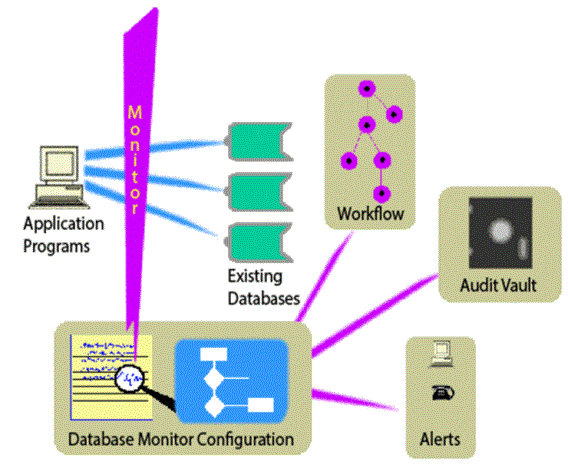
Database Monitor can be used with any IBM i application. It does not require a single change to your existing applications. Utilizing extensive database management functions of the IBM i native database, DB2, Database Monitor will detect and capture changes to any database record. Since the vast majority of data elements in a database do not require Part 11 tracking, only selected fields configured by the system administrator will be retained.
An electronic signature is collected through the use of an additional signature password that may be different than the user's IBM i password. FDA electronic signature requirements are enforced by automated presentation of pop-up screens when appropriate. If the update takes place by a batch job, or when configured to do so, a field update is captured to history for subsequent electronic signatures. Several related updates can be efficiently signed through grouping of changes.
The Software
Database Monitor is not an old security or database replication tool partially modified to capture some of the requirements of Part 11. It has been designed and programmed specifically with this regulation in mind. It has a very small footprint on the IBM i and was designed with efficiency as one of its central requirements. The following functionality is supported:
- Configuration at the database field level.
- Ability to require none, one, or several signatures
- Signatures can be required in a cascading manner creating the ability to manage work flow
- Export of history to any RDBMS system
- Secure history database
- Extensive reporting
Partnering with the developers
The principals of HelpSystems have years of application development experience in FDA regulated companies. Validation is not a foreign concept to us. Database Monitor has been developed using documented and auditable standard development methodologies (SDM) that enable speedy validation within any environment. Our personnel are available for implementation assistance and regulatory guidance when necessary. Based on the successful implementation of several validated cybersecurity systems, we know from experience that technology is only a piece of a much larger puzzle. The involvement and constant communication with the user and support community is critical to overall success. At HelpSystems, we have project management methods, industry know-how, and interpersonal skills needed for success in this extremely complex and highly regulated environment.
Post Implementation
Successful implementation of a technology is important, but maintaining the tools for the long-range is just as critical to overall success, and maximum return on investment. Our support services are staffed by seasoned professionals who have been involved with the development of the product; and who are just as comfortable in the batch mix room as they are developing software.
Conclusion
The need to rapidly implement technology solutions for the collection of electronic records and signatures in compliance with CFR 21 Part 11 cannot be ignored by any company in FDA regulated industries that plans to remain viable. Database Monitor, and other HelpSystems products, have been successfully implemented and are currently in use by large well-known pharmaceutical and food manufacturers. We have proven that we can deliver these valuable solutions effectively and rapidly.
Things to look for
As a company searches for a solution such as the one Database Monitor provides, FDA regulated manufacturers and distributors should consider:
- the vendor's experience in providing technology solutions to the industry
- the ability to validate the system
- the vendor's ability to provide technical support
- the vendor's ability to provide process support
- the vendor's ability to provide compliance advice
- the user's commitment to successful implementation from the top down
- the system's ability to comply with CFR 21 Part 11 compliance